|
|
|||||||||||||||||||||||||||||||||||||||||||||||||||||||||||||||||||||||||||||||||||||||||||||||||
|
There are often questions about what kind of an investment account a taxpayer should consider. There are several that this document will discuss:
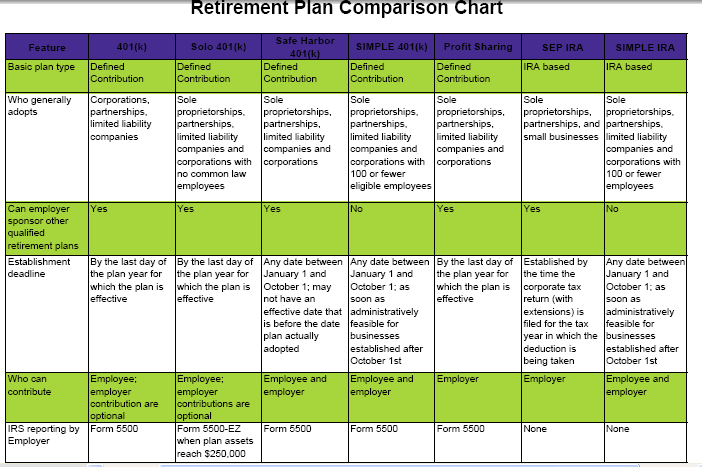
Below is a comparison chart that may help you become familiar with the differences.
A Traditional Individual Retirement Account (or Traditional IRA for short), is a special type of account which allows investors to make tax-deductible contributions. The money can be invested in stocks, bonds, mutual funds, etc., and the earnings grow tax-free until the account's owner turns 59 1/2 years old (if money is withdrawn before this age, a 10% penalty is incurred). At this time, the account holder is allowed to begin withdrawing money from the account to fund their retirement. The distributions are fully taxed by the U.S. government. Money must be withdrawn from the account no later than the April 1 following the year the owner turns 70 1/2. The traditional IRA was essentially the only choice until the late 1990's when Congress passed the Taxpayer Relief Act of 1997, at which time the Roth IRAwas created. The Traditional IRA has the following characteristics:
The exceptions for the 10% penalty are the following: 1. If the IRA owner becomes permanently disabled, money can be withdrawn without penalty.2. If the IRA owner dies before reaching 59 1/2, his or her estate will not be hit with the 10% fee for withdrawing the money early.3. In the event of serious illness or injury that requires prolonged or expensive medical treatment, the IRS will wave the earthly withdrawal fee if the withdrawals used to pay non-reimbursed medical expenses that are in excess of 7.5% of adjusted gross income.4. Withdrawals that are used to help pay for first-time home purchase (cannot exceed $10,000 during lifetime of IRA owner) will not be subject to the penalty. 5. Withdrawals that are used to pay for certain higher education costs for the IRA owner or his/her family can escape the penalty.6. Money withdrawn to pay back taxes to the IRS after a levy has been placed against the IRA will not be subject to the penalty.7. Withdrawals are used to pay medical insurance premiums after the owner of the IRA has collected unemployment for longer than twelve weeks will not be subject to the penalty.8. Withdrawals that "are a series of 'substantially equal period payments' made over the life expectancy of the IRA" holder" will not be subjected to the penalty.The traditional IRA differs from a ROTH IRA in several important areas. The most significant is that you can get a current tax deduction for your contribution (with some limitations). However, if you have an employer sponsored retirement plan, such as a 401(k), your tax deduction may be limited. In 2003, for single tax filers with an employer sponsored retirement plan, an IRA contribution was fully tax-deductible if your income was below $40,000. It is then prorated between $40,000 and $50,000. If your income was over $50,000 and you have an employer sponsored retirement plan such as a 401(k) you receive no tax deduction. For married couples the same rules apply except the deduction is phased out between 60,000 and $70,000. The phase-out ranges are scheduled to increase over the next few years. The table below summarizes the deduction phase-out for 2003 - 2007.
If your spouse has an employer sponsored retirement plan, but you do not, your tax deduction is phased out from $150,000 to $160,000. If you are married filing separately and have an employer sponsored retirement plan, the income phase-out is from $0 to $10,000. During 2004, the maximum you could contribute to an IRA (traditional or ROTH) was $3,000. This increased to $4000 for 2005, 2006 and 2007, and to $5,000 beginning in 2008.
Roth IRAs have the following characteristics:
As noted above, Roth IRA contributions are limited for higher incomes. If your income falls in a "phase-out" range you are allowed only a prorated Roth IRA contribution. If your income exceeds the phase-out range, you do not qualify for any Roth IRA contribution. The table below summarizes the income "phase-out" ranges for Roth IRAs.
If you have more than one Roth IRA, you treat them as a "single account: when you calculate the tax consequences of making a distribution from any of the accounts. As a reminder, to be tax-free, both of the following requirements must be met:
Simplified Employee Pensions, known as SEPs, represent an easy, low-cost retirement plan option for employers, without becoming involved in more complex retirement plans (such as Keoghs) Instead of establishing a separate retirement plan, in a SEP the employer makes contributions to his or her own Individual Retirement Account (IRA) and the IRAs of his or her employees, subject to certain percentages of pay and dollar limits. Employers who establish SEPs can:
Employers can contribute a maximum of 25% of an employee's eligible compensation or $40,000, whichever is less. If the limits are exceeded, there is a non-deductible penalty tax of 6% of the excess amount contributed that will be assessed for each year in which an excess contribution remains in a SEP-IRA. Employees are able to exclude from current income the entire SEP contribution. However, the money contributed to a SEP-IRA belongs to the employee immediately and always. This is important to employees because if they leave the company, all retirement contributions go with them (this is known as portability). The IRS requires employers to include all eligible employees who:
However, employers have the option to establish less-restrictive participation requirements, if desired. An employer is not required to make contributions in any year or to maintain a certain level of contributions to a SEP-IRA plan. This is a benefit for small employers because it will allow them to change their annual contributions based on the performance of the business. For calendar year corporations with a March 15, 2009 tax filing deadline, SEP-IRA contributions must be made by the employer by the due date of the company’s income tax return, including extensions. The contributions are deductible for tax year 2008 as if the contributions had actually been contributed within tax year 2008. Sole proprietors have until April 15, 2009, or to their extension deadline, to make their SEP-IRA contribution if they want a 2008 tax deduction. The SEP-IRA enrollment
process is a two page application process. The employer completes Form
5305-SEP. The employee completes the IRA investment application usually
supplied by a mutual fund company or some other financial institution
which will hold the funds. Nothing has to be filed with the IRS to
establish the SEP-IRA or subsequently, unlike many other retirement
plans that require IRS annual returns.
|
|||||||||||||||||||||||||||||||||||||||||||||||||||||||||||||||||||||||||||||||||||||||||||||||||
In a Dec. 17 letter to Rep. George Miller (D-CA), Chairman of the House Committee on Education and Labor, a Treasury official has said that IRS will not relieve retirement plan account participants and IRA owners of the need to take required minimum distributions (RMDs) for 2008. The only relief these taxpayers can look forward to is the Pension Act's waiver of the requirement to take RMDs for 2009. As background information, an owner of a traditional IRA must start taking required minimum distributions (RMDs) from his IRA by Apr. 1 of the year following the year in which he attains age 70 1/2. (Code Sec. 408(a)(6) , Reg. § 1.408-8 ) A participant in a qualified retirement plan (e.g., 401(k) plan) must begin taking distributions by Apr. 1 of the calendar year following the later of the year in which he: (a) reaches age 70 1/2, or (b) retires (except for 5% owners, who are subject to the same rules as IRA owners). But a qualified plan may provide that the required beginning date for all employees (including non-5% owners) is Apr. 1 of the calendar year following the calendar year in which the employee attains age 70 1/2. (Reg. § 1.401(a)(9)-2, Q&A 2(e)) The RMD for each year from IRAs or individual accounts under a qualified defined contribution plan is found by dividing the account balance as of the end of the preceding year by the life expectancy factor from tables in the regs. (Reg. § 1.401(a)(9)-5, Q&A 4(a)) RMDs for a particular year (except the first RMD) must be taken by Dec. 31 of that year. In general, designated beneficiaries of IRAs (including Roth IRAs) and retirement plan accounts also must take minimum distributions each year. Under Code Sec. 4974, failure to take an RMD (or failure by a designated beneficiary to take the year's minimum distribution) triggers a 50% excise tax.
Revised 12/25/2008
|
|||||||||||||||||||||||||||||||||||||||||||||||||||||||||||||||||||||||||||||||||||||||||||||||||